Brazilian folk tradition · Home use · Instant PDF
100 Herbal BathsRecipe & Tradition
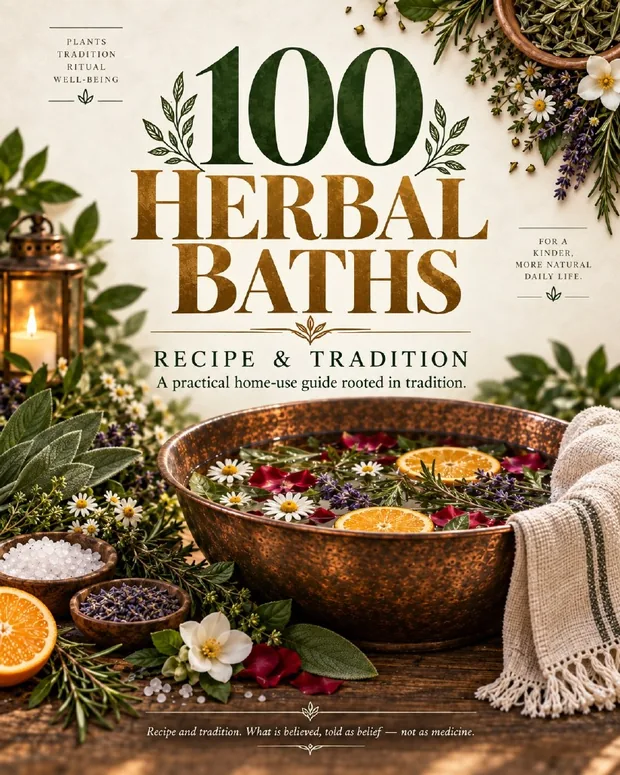
A hundred bath recipes from Brazilian folk and spiritual tradition — Umbanda, Candomblé, benzedeiras, catimbó. Written down properly, credited to where they come from, and adapted for a kitchen in the United States.
Recipe and tradition. What is believed, told as belief — not as medicine.
Start here
Bath number one. The whole thing.
Most guides tease. There is no reason to. Here is the first recipe in full — and every one of the hundred looks exactly like this. One page, always the same shape, so you can find what you need on the evening you need it.
Traditionally used when a quick cleansing bath is desired.
- Ingredients
- 2 tbsp coarse sea salt · 1 liter warm water
- Preparation
- Dissolve the salt in the warm water until fully blended.
- How to use
- Pour from the neck down after your regular shower. Do not rinse.
- When
- When you feel heavy, tense, or symbolically overloaded.
That is a complete recipe. Ninety-nine to go.
Chapter two, before a single recipe
The half almost nobody teaches
If you take a strong cleansing bath and then go straight to bed, you have done half of it.
The old rule has two steps. The strong herbs — rue, guiné, coarse salt — are the ones that take things away. That is their work. But tradition holds that they leave you open.
So a second bath follows. The quiet ones: rosemary, basil, lavender. They remove nothing. They settle what the first one stirred.
Strong first. Gentle after.
Never the other way around.
The hundred
Eight themes, and tonight's bath is in one of them
- 1–18Cleansing & uncrossing
- 19–30Protection & spiritual shielding
- 31–44Road opening & prosperity
- 45–56Love, attraction & self-esteem
- 57–68Calm, sleep, anxiety & grief
- 69–76Courage, decision & focus
- 77–88Orixá baths, in their home version
- 89–100Cycles, dates & transitions — a new year, a new home, the eve of something important
And before the recipes: warm, mild and cooling herbs and why the order matters · infusion, decoction and maceration, and which plant asks for which · the rule about the head · how much, how warm, when, and what to do with the water afterward.


The honest part
Some of these herbs are not at your grocery store
Guiné. Aroeira. Vassourinha. Quebra-demanda. A book that hands you those names and walks away has handed you nothing.
So the last four pages are a sourcing guide written for the United States: what the plant is actually called in Latin, what to type into a search box, which kind of shop carries it — and, when there is no real equivalent, that said plainly instead of invented.
- Search
- anamu · guinea hen weed · petiveria alliacea
- Where
- Caribbean and Latin botanicas · online herb sellers
- If unavailable
- No exact substitute. Rosemary and basil make a gentler home bath.
Substitutes are practical alternatives. They are not claims of ritual equivalence.
Scope
Where this book stops
No amaci. No head baths. No initiation baths. Nothing that belongs to a terreiro, or that needs a pai or mãe de santo.
Those are not missing by accident. They were left out on purpose, and the book says so on a page of its own, with the reason.
This book teaches what is done at home.
The rest has its place, and that place is not a PDF.
Care
Every plant is named, and the risky ones say so
Rue is a real herb with real properties: not during pregnancy, and not before sun. Guiné is external use only, always diluted, never ingested. Both carry their warning printed on the recipe itself, not buried at the back.
Three plants that circulate freely in online bath lists — dumb cane, castor bean and physic nut — are excluded from this book entirely, with photographs and the reason why.
And every one of the hundred carries its botanical name, because a common name changes from one town to the next.
100 Herbal Baths
$17
Instant download. Yours to keep.
- 100 recipes
- 34 pages
- Reads on your phone
Questions
Do I need to belong to a religion to use this?
No. Everything here is home use. The book credits the traditions these recipes come from — Umbanda, Candomblé, benzedeiras, catimbó — rather than pretending they came from nowhere, and it leaves out what belongs to a terreiro.
Is this medical advice?
No, and it never pretends to be. Every recipe is written as belief and tradition. Nothing here diagnoses, treats, cures or prevents anything.
What if I cannot find one of the herbs?
The sourcing guide covers it: the botanical name, what to search, which kind of shop carries it, and an honest substitute where one exists — or a clear note when one does not.
Will I need a cabinet full of rare plants?
No. A good number of the hundred use rosemary, basil, bay, chamomile, lavender, coarse salt, orange peel and cinnamon — things already in most kitchens. You can start tonight with bath number one.
What exactly do I get?
A 34-page PDF, downloaded the moment you buy, yours to keep and to read on a phone.